
European Framework of Reference
Our German courses span the six levels A1 to C2 of the Common European Framework of Reference for Languages (CEFR). Each level covers the four criteria of listening comprehension, reading comprehension, oral expression and written expression.
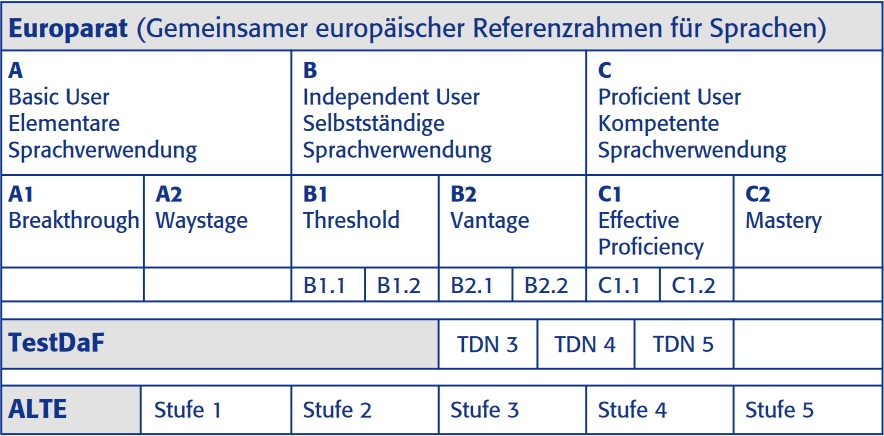
What every level covers
At each level, four skills are developed equally and assessed in our exams.
Listening comprehension
Understand spoken German in everyday life, at work and in the media.
Reading comprehension
Read, grasp and evaluate texts of all kinds.
Oral expression
Speak freely, coherently and appropriately to the situation.
Written expression
Write your own texts clearly and correctly.
Basic language use
At the basic level you acquire the ability to use the language in elementary ways.
A1 Basic level — no prior knowledge
You can understand and use familiar everyday expressions and very simple phrases aimed at the satisfaction of concrete needs. You can introduce yourself and others and can ask other people questions about themselves — for example where they live, the people they know or the things they have — and can answer questions of this kind. You can interact in a simple way provided the other person talks slowly and clearly and is prepared to help.
A2 Basic level
You can understand sentences and frequently used expressions related to areas of most immediate relevance (for example personal and family information, shopping, work and the local area). You can communicate in simple and routine tasks requiring a simple and direct exchange of information on familiar and routine matters. You can describe in simple terms your own background and education, your immediate environment and matters in areas of immediate need.
Independent language use
At the intermediate level you reach independent language use.
B1 Intermediate level
You can understand the main points when clear standard language is used and when the topic concerns familiar matters such as work, school and leisure. You can deal with most situations likely to arise while travelling in an area where the language is spoken. You can express yourself simply and coherently on familiar topics and areas of personal interest. You can describe experiences and events, dreams, hopes and ambitions and give brief reasons and explanations for opinions and plans.
B2 Intermediate level
You can understand the main ideas of complex texts on both concrete and abstract topics; you also understand specialised discussions in your own field. You can communicate spontaneously and fluently enough that a normal conversation with native speakers is quite possible without strain for either party. You can express yourself clearly and in detail on a wide range of subjects, explain a viewpoint on a topical issue and give the advantages and disadvantages of various options.
Proficient language use
At the advanced level you reach proficient language use.
C1 Advanced level
You can understand a wide range of demanding, longer texts and grasp implicit meaning. You can express yourself spontaneously and fluently without much obvious searching for words. You can use the language flexibly and effectively for social, professional, academic and educational purposes. You can express yourself clearly, in a well-structured and detailed way on complex subjects, using a range of cohesive devices appropriately.
C2 Advanced level
You can understand with ease virtually everything you read or hear. You can summarise information from different written and spoken sources, reconstructing arguments and explanations in a coherent presentation. You can express yourself spontaneously, very fluently and precisely, conveying finer shades of meaning even in more complex situations.
What level are you?
Take our free placement test and find out which CEFR level you should start at.